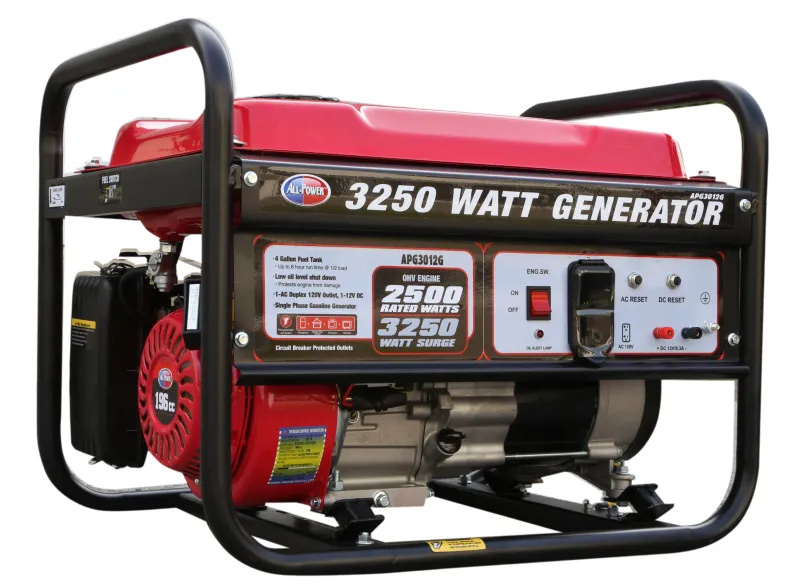
You're Probably Running Your Coleman PowerMate in the Wrong Spot — Here's Why It Matters
Most people think generator placement is simple: get it outside, away from the house, and you're good. And while that instinct is pointed in the right direction, it barely scratches the surface of what smart positioning actually looks like. Where you put your Coleman PowerMate — and how you set it up — directly affects runtime, fuel consumption, power output, and in worst-case scenarios, whether carbon monoxide finds its way into your living space.
Let's dig into this. There's more going on than most owners realize.
Why Location Affects Performance (It's Not Just About Safety)
Start with the basics: generators are internal combustion engines. Like any engine, they're sensitive to airflow, temperature, and load conditions — all of which are influenced by where you place them.
Heat is the enemy of efficiency. When a generator runs in a confined or poorly ventilated space, the engine temperature climbs. Higher operating temps reduce combustion efficiency, which means you burn more fuel to produce the same amount of power. On a hot August afternoon in Texas or Georgia, even outdoor placement matters — setting your PowerMate in direct sun on a 95°F day is a fundamentally different operating environment than placing it in partial shade with good airflow.
Elevation and airflow affect the carburetor. Generators running at altitude — say, you've hauled your Coleman PowerMate to a mountain campsite in Colorado or North Carolina — will run rich because the air is thinner. That translates to incomplete combustion, reduced power output (sometimes 3-4% per 1,000 feet of elevation), and increased fuel consumption. Some models have altitude adjustment screws on the carburetor; consult your manual.
Surface matters more than you'd think. Running your generator on soft ground, grass, or uneven terrain can restrict the airflow vents underneath the unit, trap heat, and in wet conditions, allow moisture to wick up into components. A flat, hard surface — concrete, asphalt, a portable generator mat — is always the better call.
The Carbon Monoxide Reality Check
This is where we need to stop and be completely direct: carbon monoxide (CO) from generators kills people every year in the United States. According to the CDC, generator-related CO poisoning causes hundreds of deaths and thousands of emergency room visits annually, with the highest rates occurring during and after major storms when people are running generators continuously.
Here's the thing — CO is invisible and odorless. You won't smell it. You won't see it. By the time you feel it, you may not be able to act.
The dangerous placement mistakes that cause CO poisoning aren't exotic. They're ordinary:
- Running a generator in a garage, even with the door open. This is one of the most common scenarios. CO concentrations inside a garage can reach dangerous levels within minutes, and the gas seeps into the attached home through gaps around doors and walls. Keep your PowerMate completely outside — period.
- Placing it near windows, doors, or vents. Exhaust from your generator needs to go somewhere, and if it's pointed at or near an opening into your home, CO will find its way inside. The general guidance is a minimum of 20 feet from any opening — windows, doors, dryer vents, HVAC intakes — but more distance is always better.
- Running it on a porch or under a carport. Covered structures trap exhaust gases just like an enclosed space. Even a breezy day doesn't guarantee adequate dispersal in a partially enclosed area.
- Assuming wind direction will protect you. Wind shifts. Don't rely on it as your safety margin.
If you don't already have CO detectors in your home, install them now — before the next outage. It's a $20 to $30 investment that could literally save your life.
Smart Placement for Home Backup Use
For most PowerMate Hub readers, the most common use case is home backup during power outages. Here's how to set up your positioning correctly:
-
Pick a permanent spot before you need it. Don't figure this out during a storm at midnight. Walk around your home now and identify a location that's at least 20 feet from any doors or windows, has a hard flat surface, and is accessible enough that you can safely run extension cords or a transfer switch connection to your house.
-
Think about prevailing wind direction. Position the exhaust side of your generator so that wind naturally carries exhaust away from your home, not toward it. You can't control wind, but you can make the default condition work in your favor.
-
Consider a generator tent or canopy. Running in the rain creates its own problems — wet conditions increase risk of electrical issues. Purpose-built generator enclosures allow operation in wet weather while maintaining the open-air ventilation you need. Do not use a standard tarp draped over the unit — it restricts airflow and creates a fire hazard.
-
Keep it away from dry vegetation. Generator exhaust and engine heat are ignition sources. Dry grass, leaves, and mulch around your generator aren't just a nuisance — they're a fire risk.
Placement for RV and Camping Use
If you're running your Coleman PowerMate at a campsite or alongside an RV, the same CO principles apply with some additional wrinkles.
Never run a generator in an RV storage bay or underneath the vehicle. Position it outside, downwind from the RV's windows and door, on level ground. Be aware of neighboring campers — generator exhaust and noise drift, and a poorly positioned unit can push CO toward someone else's tent or RV. Many campgrounds have specific generator zones and hours; respect them.
For tailgating and outdoor events, keep the generator at the perimeter of your setup, exhaust pointed away from the crowd. This sounds obvious, but at a packed parking lot or festival setup, people get creative with space and end up with generators tucked into corners surrounded by chairs and coolers.
Placement for Jobsite Work
On a construction or renovation site, generator placement tends to be improvised and frequently moved. A few rules of thumb:
- Keep it off dirt and mud — moisture and debris ingestion are real problems.
- Don't run it inside partially completed structures, even if they seem open. Framing with sheathing on the outside creates CO traps faster than you'd expect.
- Position it so the cord runs aren't a tripping hazard across active work areas.
- If you're powering tools that are sensitive to voltage fluctuations (like variable-speed tools or compressors), keep cord runs as short as practical — longer extension cords create voltage drop that affects performance.
The Bottom Line
Your Coleman PowerMate is a capable, well-built machine. But it performs at its best — and keeps you safest — when you're thoughtful about where and how you deploy it. A few minutes of planning before you ever pull the recoil handle can mean better fuel economy, longer runtime, and most importantly, a family that wakes up healthy the next morning.
When in doubt, go farther from the house, stay on solid ground, and keep that exhaust pointed away from anything with people in it.